July 10 5:00 AM
Beginning Monday 7/13/2026 Route 8 and 10 will be serviced on Main & 8th
Route 9: Detour for the inbound 9 all day. No stops missed.
Stop at CWI Main Campas will be closed. Park and Ride will be open.
The inbound stop at Vista and Sun Rise Rim is closed due to construction. Temp stop has been placed near side in front of the Ramada Inn.
The stop on Latah and Alpine towards MSS is closed for construction and temp stop placed on the far-side of the R&R tracks.
Due to construction, inbound stop at 9th Street is closed
Inbound stop on State and 11th is closed, temporary stop placed at State and 12th near side.
Outbound route 21 stop on Milwaukee and Goddard is closed for construction and no temp stop placed.
Beginning June 8, routes 8, 10 and 40 will be stopping at 9th and Main due to Main Street Road closure. Visit our website for more information ridevrt.org/changes.
Outbound and inbound will be on long term detour at Fort and 15th area due to construction. No stops will be missed for both routes.
Route 9 OB stop at State and Ellen's Ferry closed. No temp stop placed.
Stop at 9th & River will be closed due to construction from 5/11/2026 to 7/31/2026. No temp stop placed.
Inbound State and Pierce Park stop closed, no temp placed due to construction.
Route 16: Stops on 1st & Idaho and 1st & Bannock will be closed. Please use the bus stop on Main & 1st.
Each year as we develop a budget for the upcoming fiscal year, VRT requests funding from partner agencies to fund operations and capital projects. This year, the City of Nampa asked us to explore more efficient ways to provide service and reduce our funding request for fiscal year 2027 (which runs October 1, 2026, through September 30, 2027) from the original proposal of ~$860,000 to less than $500,000.
Following the City of Nampa’s desire to reduce the budget request, VRT staff have developed a service proposal that costs $498,522 and aligns with the city’s request. The proposed changes, along with a survey to provide feedback on the proposed changes, can be found below.
Each year as we develop a budget for the upcoming fiscal year, VRT requests funding from partner agencies to fund operations and capital projects.
This year, the City of Nampa asked us to explore more efficient ways to provide service and reduce our funding request for fiscal year 2027 (which runs October 1, 2026, through September 30, 2027) from the original proposal of ~$860,000 to less than $500,000.
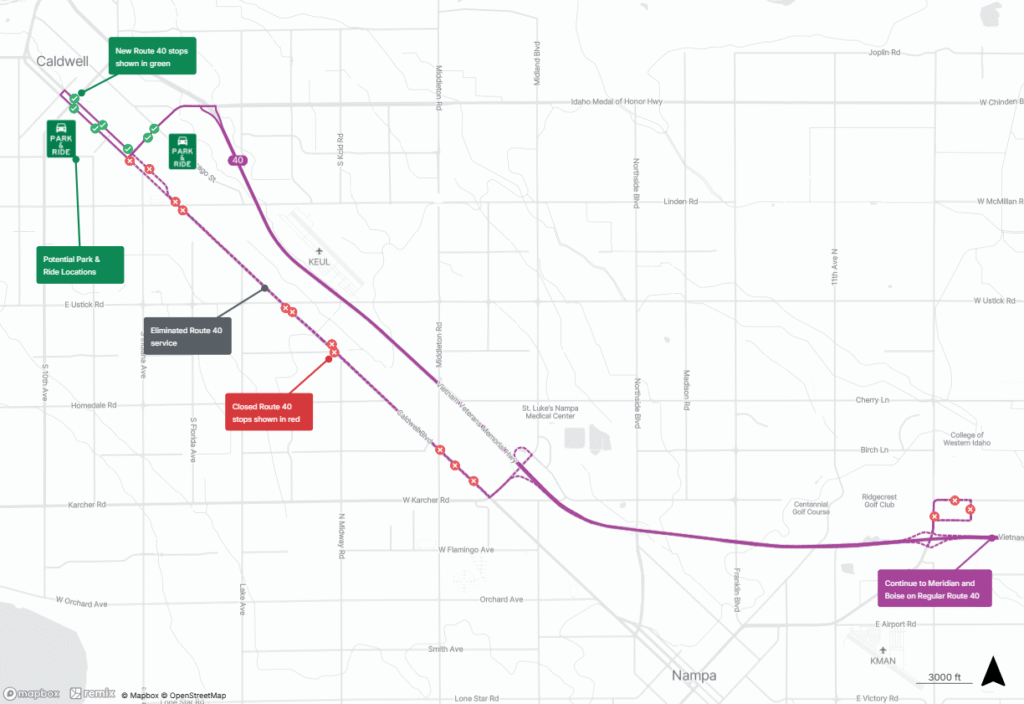
Following the City of Nampa’s desire to reduce the budget request, VRT staff have developed a service proposal that costs $498,522 and aligns with the city’s request. This proposal removes Route 40 from Nampa, maintains Route 42, changes how VRT On-Demand operates, and adds an additional ride hailing option. This proposal also introduces emerging best practices in the on-demand service model that lower costs and increase efficiency in boarding per hour.
Our aim is to work within the budget outlined by the City of Nampa, while maintaining a best practice service model, providing as much service for Nampa residents as possible, service continuity for existing Caldwell riders, and jobs for our Canyon County staff.
VRT staff will be presenting this proposal to Nampa City Council on June 15th. We will also be hosting an open house and public hearing on June 22nd beginning at 3:30 p.m. to share the proposal with the public and hear testimony.

Nampa residents: Nampa would lose direct access to downtown Boise and Boise State on Route 40. Nampa residents would have to use VRT On-Demand or Park & Rides in Caldwell or Meridian to access Route 40. Residents could also access Route 40 by taking Route 42 to Overland & Black Marlin. Route 42 will continue to connect with other Boise services at Towne Square Mall.
Accessible rides: Riders on the 150 will be offered TNC options when TNC service is more efficient. TNC services are typically not accessible, so passengers with mobility devices may wait for a VRT On-Demand trip offerings if they are not able to accept a TNC trip.
Leveraging TNC’s: Shifting long or short trips from VRT On-Demand to TNC will allow VRT On-Demand to focus on shared rides and accessible rides. We expect there may be as many as 25% of the total VRT On-Demand trip requests provided by TNC’s. This change may increase the productivity and availability of on-demand service.
Caldwell residents and CWI access: Caldwell riders will no longer have direct access to CWI. Caldwell riders will have to use VRT On-Demand or catch Route 42 at the Happy Day Transit Center to get to CWI.
Ridership: We anticipate a loss in ridership on Route 40 due to loss of Nampa riders. Currently approximately 17% of Route 40 riders board in Nampa. Nampa ridership loss could be off set by more Caldwell riders attracted to a faster trip to Boise. Travel time between Caldwell and Boise is expected to reduced by approximately 15 minutes (see images below). We also anticipate growth on Route 42 as Nampa and Caldwell riders use 42 to fill holes created by change in Route 40.
If a trip would be better served by a TNC (for instance, if it is too long or too short to match with other VRT On-Demand rides), the rider would be offered that trip instead. If the rider accepts the TNC trip, they would be seamlessly connected to the TNC service. This option would be available during the booking process through Via (both in the app and by calling Customer Service). Riders would not have to have a separate TNC app to complete the trip and would be able to pay for their TNC trip within the VRT Booking app. Staff would also be trained in how to book these rides if someone cannot use the VRT Booking app.
The fare for a TNC offering would be $2.00, which is higher than regular bus fare but far less expensive than going through a TNC independently. The hours would be the same as VRT On-Demand and the service area would mimic that of VRT On-Demand.
All vehicles used for VRT On-Demand will be accessible for mobility devices. Any passenger requesting an accessible ride will only be matched to VRT On-Demand as TNC vehicles are not typically accessible.
VRT Access service area will stay the same. VRT expects to shift the operation of VRT Access to the new VRT On-Demand service provider.
There are no changes planned to the VRT On-Demand service area or service span. VRT On-Demand riders would still be able to travel to the same locations in Canyon County, including Caldwell and CWI. Changes to Route 40 would impact Caldwell and CWI as described above (i.e. Caldwell loses some of its direct fixed route access to CWI). CWI would no longer be served by route 40 but will continue to have direct service to downtown Meridian, and Boise via route 45. CWI and Caldwell riders would still be able to use VRT On-Demand and Route 42 to access destinations using public transit.
Members of the public can fill out the survey, attend the open house and public hearing on June 22nd, and speak with their city council representative.
Based on current state statute, VRT is not in control of our own revenue like other government agencies that can directly collect taxes and reliably forecast revenue based on property, sales or other taxes. VRT relies on voluntary contributions of our funding partners (cities, counties, and universities). If those partners are unable or unwilling to provide consistent funding each year, VRT has to adjust expenses to meet the budget we are given, which often results in service cuts.
Additionally, the Idaho State Legislature passed a bill four years ago that restricts our partners’ ability to grow their budgets to keep up with the demands of growth. This makes it more difficult for them to fully fund VRT services, especially since ours is not a statutory requirement for them.
VRT makes every attempt to retain as much service as possible and leverage resources for our riders. Lacking the ability to collect taxes, we have always faced the challenge of maintaining minimum public transportation service, let alone grow the services that we know the valley needs.
Last year, we faced a similar challenge in Nampa and proposed several changes to service. This culminated in the Canyon County Transit Day last May where we heard from over 200 Canyon County residents and multiple local institutions about the importance of public transportation in Canyon County. As a result of that effort Nampa included VRT’s full request in their FY2026 budget.